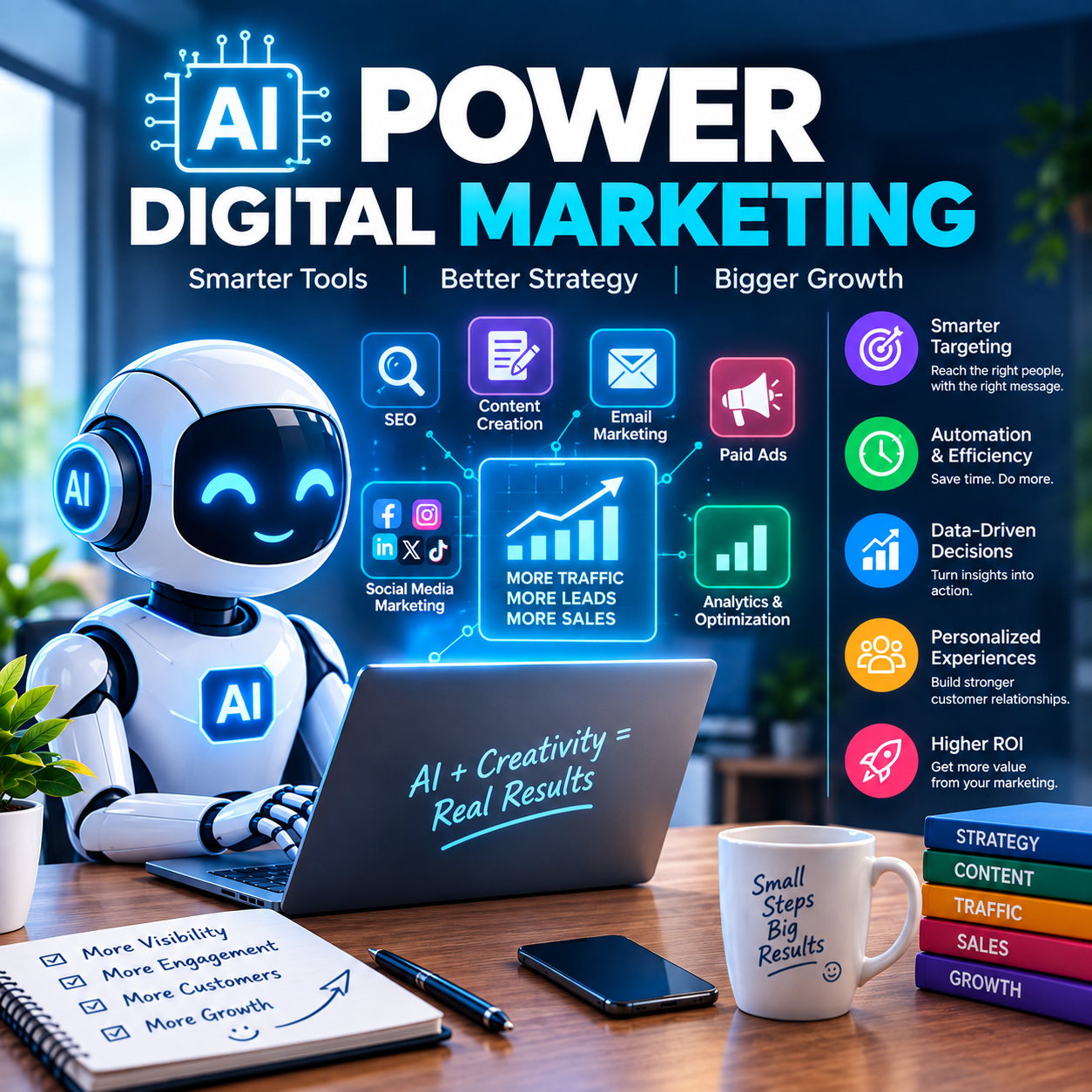
Why AI Will Replace Digiscaleup: The Rise of AI-Powered Growth
Artificial intelligence has moved from experimentation into everyday business operations. Today, companies use AI tools to automate tasks, analyze data, personalize communication, and improve marketing performance.This transformation is creating new possibilities for digital growth. At the same time, it is challenging traditional marketing processes and service models.For Digiscaleup, this change deserves serious attention. AI in Digiscaleup could automate activities that previously required dedicated teams, lengthy workflows, and extensive manual effort.However, the idea that AI will simply eliminate Digiscaleup requires closer examination. Artificial intelligence may replace specific functions while creating demand for new capabilities.The real question is not whether AI will change Digiscaleup. The more important question is how deeply AI will transform its existing operating model.
AI in Digiscaleup Is Transforming Digital Marketing
Traditional digital marketing depends on research, execution, optimization, and reporting. These activities often involve repetitive processes and large volumes of information.AI tools can now support many of these activities. They can analyze customer data, identify patterns, generate content ideas, summarize reports, and assist with campaign planning.Consequently, businesses can complete certain marketing tasks faster. They can also reduce the amount of manual work required for routine operations.AI in Digiscaleup could therefore become a central component of digital growth. Instead of treating AI as an additional technology, companies can integrate it into their core workflows.For example, AI can analyze campaign performance and identify potential improvements. It can also organize customer information and support personalized communication.Furthermore, AI can help teams monitor changing search behavior and customer interests. This capability can improve the speed of marketing decisions.The result is a more automated digital marketing environment.
Why AI Tools Could Replace Traditional Marketing Processes
The strongest argument for AI replacing parts of Digiscaleup comes from automation.Many marketing activities follow repeatable patterns. Research, reporting, segmentation, content preparation, and data analysis can involve predictable workflows.AI tools are particularly effective at processing these repetitive activities.For instance, an AI system can process large datasets quickly. It can identify trends and organize information without requiring every task to be completed manually.Similarly, AI-powered content systems can produce initial drafts within seconds. Marketing teams can then review, refine, and approve the output.Email marketing also demonstrates this shift clearly. AI can help analyze customer behavior and identify suitable audiences for different campaigns.It can also support subject-line generation, content variations, segmentation, and performance analysis.Therefore, businesses may require fewer resources for routine marketing execution.This does not necessarily mean that human marketers become irrelevant. Instead, their responsibilities may move toward strategy, supervision, creativity, and decision-making.For Digiscaleup, this shift could fundamentally change how services are deliverd.
AI in Digiscaleup Could Create Faster and More Scalable Growth
Speed has become a major competitive advantage in digital marketing.Traditional workflows can involve multiple stages before a campaign reaches customers. Research must happen first, followed by planning, production, review, launch, and analysis.AI can compress several of these stages.AI tools can generate research summaries and campaign ideas rapidly. They can also assist with audience segmentation and performance analysis.As a result, businesses can test more ideas within shorter periods.This creates another important advantage: scalability.A traditional marketing workflow may require additional people as campaign volume increases. AI-powered workflows can potentially handle higher volumes without increasing staffing at the same rate.AI in Digiscaleup could therefore improve operational efficiency.Businesses may create more campaigns, analyze more customer interactions, and personalize more communication while maintaining streamlined operations.Additionally, AI can operate continuously. It does not depend on traditional working hours for every analytical or administrative task.This can help organizations respond to changing customer behavior more quickly.
The Role of AI Tools in Email Marketing and Customer Engagement
Email marketing provides a strong example of AI-driven transformation.Modern email campaigns depend heavily on customer data. Marketers need to understand interests, engagement patterns, previous interactions, and campaign responses.AI tools can analyze these signals and support more relevant communication.For example, AI can help identify customer segments based on behavioral patterns. It can also support personalized messaging for different audience groups.Campaign optimization can become increasingly automated as well.AI systems can analyze open rates, clicks, conversions, and other performance indicators. They can then help marketers identify opportunities for improvement.This creates a feedback loop.Customer behavior generates data. AI analyzes the data. Marketing teams use the insights to improve communication. New campaigns generate additional data.Over time, this process can become increasingly efficient.AI in Digiscaleup could therefore change email marketing from a primarily manual activity into an intelligent, data-driven system.However, human oversight remains important. Businesses still need clear brand guidelines, accurate messaging, ethical data practices, and meaningful communication.
Will AI Completely Replace Digiscaleup?
AI will likely replace some traditional processes. Complete replacement, however, is a more complicated question.Artificial intelligence can process information and automate workflows. Yet business growth involves more than processing information.Companies still need positioning, strategic direction, creative thinking, relationship management, and business judgment.These responsibilities can become even more important as AI tools become widely available.If every company has access to similar AI capabilities, technology alone may not provide a lasting advantage.The advantage will come from how businesses use that technology.Digiscaleup can respond by integrating AI throughout its operations. Instead of competing against AI, it can use AI to deliver faster and more scalable services.This approach could create an AI-powered version of Digiscaleup.Such a model could combine automated research, intelligent analytics, personalized marketing, content assistance, and human strategy.The result would not necessarily be the disappearance of Digiscaleup. Instead, it could represent the evolution of Digiscaleup.
The Future of AI in Digiscaleup
The future of digital marketing will likely become increasingly AI-driven.AI tools will continue improving their ability to analyze information, automate repetitive processes, and support decision-making.For Digiscaleup, adapting early can create significant opportunities.The organization can identify repetitive tasks and determine where automation provides the greatest value. It can then redesign workflows around AI while maintaining human quality control.This approach can reduce operational friction.It can also allow teams to spend more time on high-value activities.For example, marketers could focus more heavily on campaign strategy and customer relationships. Meanwhile, AI could support research, reporting, personalization, and routine execution.This division of responsibilities could create a more efficient operating model.The same principle applies to email marketing.AI can handle increasingly sophisticated analytical tasks. Humans can remain responsible for brand voice, strategic decisions, and customer experience.Therefore, the future is unlikely to be purely human or purely automated.Instead, successful organizations will combine both capabilities.